
Blog
AI in Nursing: 7 Surprisingly Real Ways Artificial Intelligence Is Changing Your Shift

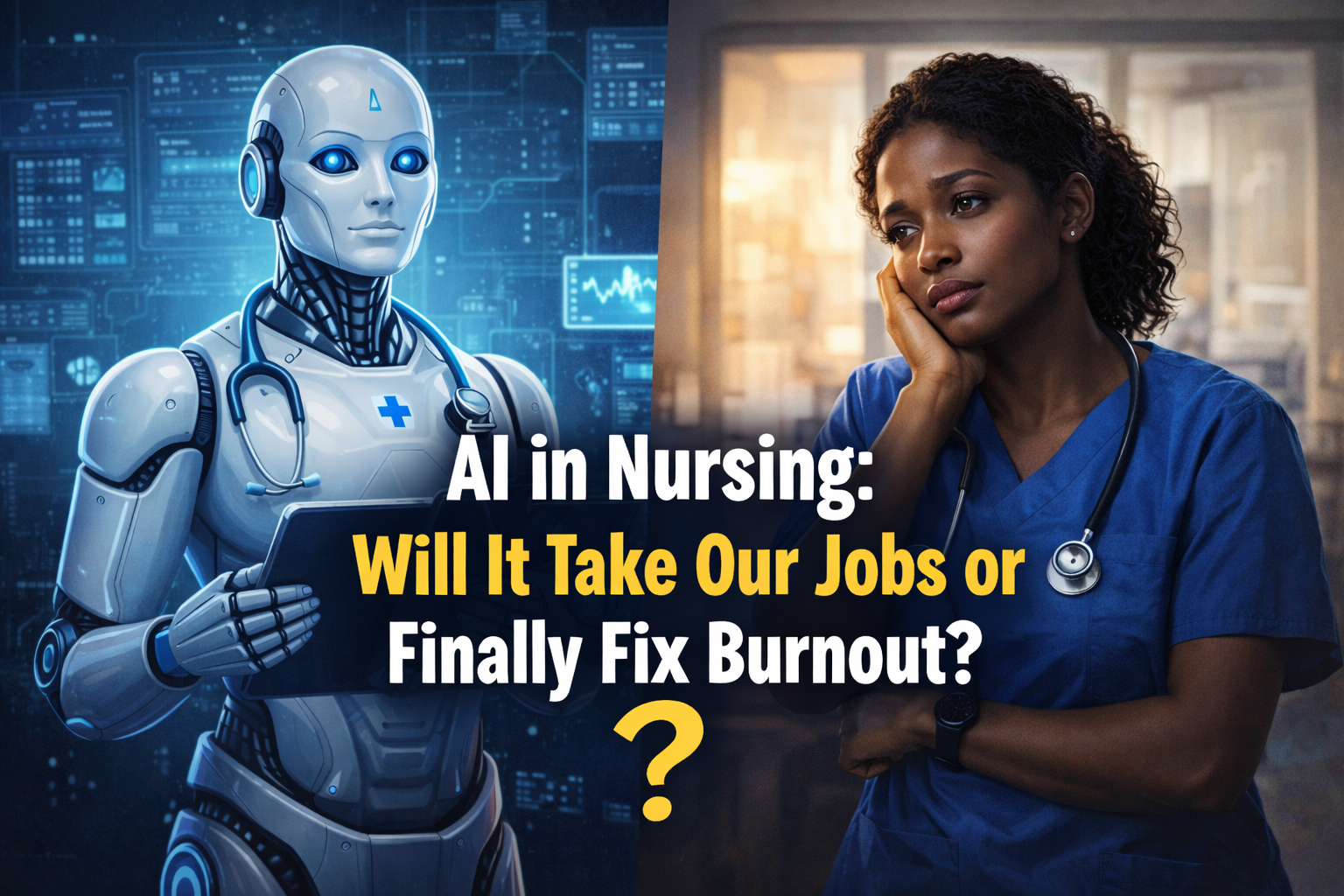
You’ve probably heard that “AI is coming for healthcare” — but if you’re standing in a busy ward with three call bells ringing and one vein left to cannulate, it can feel very far from your reality.
Here’s the truth: AI in nursing is already here, and it’s creeping into our work in small, practical ways — from vitals monitoring to staffing tools — not just in sci-fi robots and fancy research units (1–3).
In this blog, we’ll unpack what AI in nursing actually is (in normal language), how it might quietly reshape your shifts, and how you can stay in control – while still adding some fun with cute, practical gear from NurseLife.
You can always explore gear to make your real, non-robot shifts easier here:
https://nurselife.co.za/shop/
What is AI in Nursing (In Real-Life Terms)?
Recent reviews show AI now touches education, clinical care, workload management and how nurses themselves feel about these tools (1–3).
The good news? Most of this tech is designed to support nurses, not replace them. The bad news? If we ignore it completely, we risk having systems built without our input.
If you want a deeper dive into examples, the USAHS blog on AI in nursing is a great overview:
“AI in Nursing: How AI Is Transforming Nursing Practice” – just search that title if you want to read more.
Another accessible summary is “Artificial intelligence in nursing education: opportunities and challenges” (1).
In simple terms: AI is a tool that can help you make sense of information and automate repetitive tasks – but you are still the nurse.
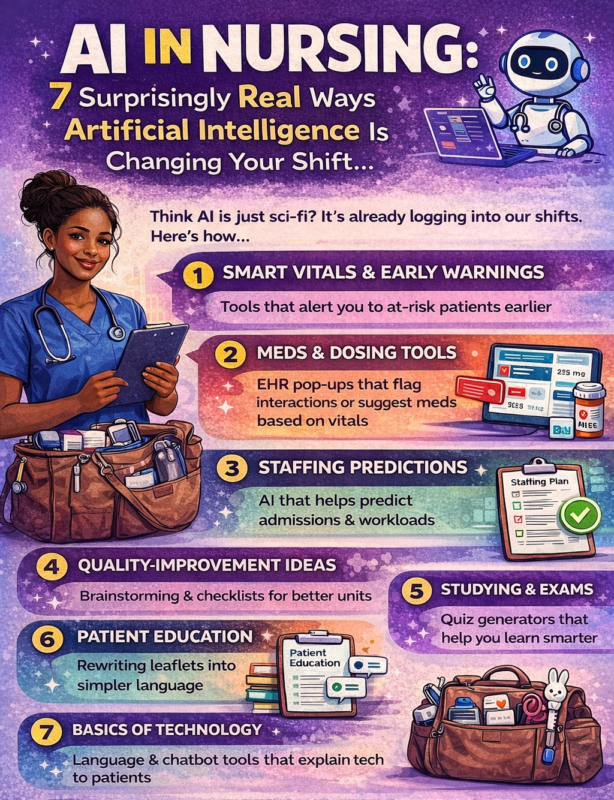
Where You Might Already Be Using AI on Shift
You might be using AI without even realising it. Here are some everyday examples:
• Smart vitals and early-warning scores
Monitors and hospital systems that automatically flag “at-risk” patients often use AI algorithms to predict deterioration from patterns in heart rate, blood pressure and other data (2,3).
• Decision support pop-ups
When your electronic record suggests meds, flags interactions, or recommends dosages based on weight and renal function, those rules and models are part of AI-driven decision support (2).
• Staffing and workload tools
Some hospitals use AI to predict admissions, discharges and workload, then suggest staffing levels or redistribute beds more efficiently (2,3).
• Learning platforms and simulations
AI-enhanced nursing education can adapt quizzes, build scenarios, or give personalised feedback based on your answers. This is becoming a big area in nursing education (1,3).
So no, AI isn’t just a robot nurse rolling down the corridor. It’s often hidden in software you already log into daily.
How AI Could Help Your Practice (If Used Well)
Studies on AI in nursing show a few consistent benefits when systems are thoughtfully implemented (2,3).
Better early detection
- AI can pick up subtle risk patterns (like sepsis or deterioration) that humans might miss when things get busy.
- Earlier detection can lead to quicker interventions and potentially better outcomes.
Less time on admin, more time with patients
- Documentation support, auto-filling routine fields and structured prompts can free up time for actual patient care.
- Workflow tools can help distribute workloads more fairly across the team.
Some research suggests these changes can reduce stress and improve nurse satisfaction – especially when nurses are involved in designing and testing the tools (2,3).
Support for decision-making
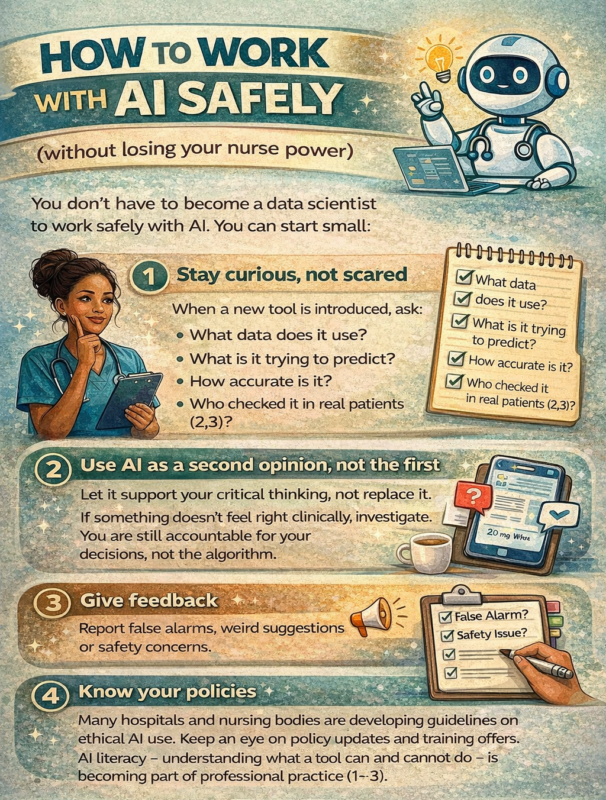
AI doesn’t replace your thinking – it supports it:
- You get extra information and pattern recognition.
- You can cross-check what you’re seeing with what the system suggests.
- You can feel more confident that you’ve considered key risks.
Think of AI as a very fast second opinion – but your professional judgment is still central.
The Flip Side: What Nurses Are Worried About
Of course, nurses aren’t just excited – we’re cautious (and we should be).
Reviews and integrative studies on AI in nursing highlight several real concerns (1–3):
- Loss of the “human touch” – Nurses worry that over-relying on AI could make care feel more technical and less relational.
- Algorithm bias – If AI is trained on biased data, it may be less accurate or fair for certain patient groups.
- Transparency – Many tools are “black boxes,” and it’s not always clear why a system made a certain recommendation.
- Job anxiety – Some nurses fear that AI might gradually replace tasks they currently do, or reshape roles without proper consultation.
- Ethical and privacy issues – Data security, consent and surveillance are major ethical considerations when using AI in health settings (1–3).
That’s why nurses need to be at the table when hospitals choose or design AI tools – not just trained on them after decisions are already made.
Spicing Up the “AI Shift” with Cute, Functional Gear
Whether AI is helping with documentation or flagging deteriorating patients, you’re still the one on the floor doing the real work. If tech is getting smarter, your gear can level up too.
Here are some fun, practical ways to make your AI-enhanced shifts more enjoyable:
Stay organised when the system pings
AI alerts can come at awkward times. Having a dedicated, easy-to-grab pouch for your essentials (scissors, penlight, alcohol swabs, mini notebook) means you can respond quickly without rummaging in your pockets.
Protect your tech
If you’re using tablets or phones linked to AI tools, a good-quality, wipeable sleeve or organiser helps keep everything clean and safe from spills.
Wear-your-mood accessories
Cute badge reels, fun socks or colourful pen sets might seem small, but they bring a bit of personality back into a shift that can otherwise feel very “digital”.
Comfort gear for long, tech-heavy shifts
AI might optimise bed management, but it can’t stop your feet from hurting. Cushioned socks, supportive shoes, and a roomy, organised nurse bag are still essential.
You can browse nurse-friendly bags, pouches, and accessories here:
https://nurselife.co.za/shop/
So… Is AI in Nursing a Threat or an Opportunity?
Current evidence suggests AI is more of a tool than a threat – but only if nurses stay involved in how it’s designed, implemented and evaluated (2,3).
Think of AI like a super-fast, slightly nerdy colleague who never sleeps:
- Great at calculations, pattern recognition and data crunching.
- Terrible at empathy, values and context without your guidance.
Your clinical judgment, advocacy and human connection remain non-negotiable. AI can help you detect risk earlier, document faster and manage workload more intelligently – but it can’t replace your nurse brain or your nurse heart.
So keep learning about AI, keep asking questions, and keep showing up as the human in the loop. And if you’re going to be part of the future of nursing, you might as well do it with a cute, organised bag and a pen that actually works. 💙
References (Vancouver style)
- Glauberman G, Ito-Fujita A, Katz S, Callahan J. Artificial intelligence in nursing education: opportunities and challenges. Hawaii J Health Soc Welf. 2023;82(12):302–305.
- Ventura-Silva J, Martins MM, Trindade LdL, Faria AdCA, Pereira S, Zuge SS, et al. Artificial intelligence in the organization of nursing care: a scoping review. Nurs Rep. 2024;14(4):2733–2745.
- El Arab RA, Al Moosa OA, Sagbakken M, Ghannam A, Abuadas FH, Somerville J, et al. Integrative review of artificial intelligence applications in nursing: education, clinical practice, workload management, and professional perceptions. Front Public Health. 2025;13:1619378.
